Why ISM
Introduction, here we explain some of the why’s and how to’s.
Why INNER Stress Management?
Stress is an important part of life. We need it to grow.
If stress turns into distress. It requires healthy management skills.
We suggest managing stress from the inside-out. Outside stressors can not be eliminated, but we can change our inner
relationship with the stress in our lives. The goal is to develop three simple inner management skills grounding, opening and
understanding.
Why learn the skills of grounding, opening and understanding?
- Grounding release the stress that forms in the mind.
- Opening restores the emotional energy.
- Understanding reduces future stress.
How to use the website- start by quickly clicking through the entire site. Watch for the materials that the mind is most
interested in. ?If there is interest but not enough time bookmark the site and return later. ~Tip~ where there is interest, the
learning and practicing will be the easist.
How to start studying– below are 10 Stress Meditation basics that may answer some questions regarding meditation.
or for more stress meditation resources, please check out our other websites below:
* Website- The Community Forum
* Website- CaringAwareness.com
Health and Happiness, Heidi & ross
+++
ISM Manual
Inner-Stress Management
Release Daily Stress
Rebalance? Emotions
Reduce Future Stress

?It?s gotta be fun?
WORKSHOP OVERVIEW
OBJECTIVE: To provide educational materials and practices that support having more fun & less stress.
GOALS: The 3 Goals of Stress Reduction Meditation are to:
- Release daily stress.
- Restore the emotions.
- Reduce future stress.
STUDY: What is taught?
- How use mindfulness (attention) of the body to releases stress.
- How to care (intention) for what is what is happening in our body, heart and mind.
- How to inquire and understand the stressors, and there by allowing more enjoyment of life.
PRACTICE: We practice the development of intention and attention. The 3 practices are:
- ?Stopping & Dropping? (to release daily stress)
- ?Opening & Smiling? (to restore the emotions)
- ?Inquiring to Understand? (to reduce future stress)
APPLYING: These mindfulness practices result in learning new skills that can then transfer into our daily life. This results in reduced stress and improved relationships, creativity and increases our emotional intelligence quotient (EQ).
PSYCHOLOGICAL BENEFITS:
- Decreased, anxiety, depression, irritability and moodiness
- Increased, happiness, emotional stability, learning ability and memory
MEDITATION TIPS:
*Continuously, let go of expecting too much of ourselves or self-judgments and aversions.
*When confused or concerned always gently return to the grounding sensations of the hands.
*Life can sometimes be taken too seriously, the Stress Reduction Yogi?s motto is. ?its gotta be fun?
CONCERNS:
- If you have any concerns or questions please let us know.
- Not religious, based on western science, eastern meditation & experience.
- In all movements and meditations, please do only what feels comfortable for you.
Disclaimer:
1. Generalizations are used sometimes to simplify the complexities of the body, heart and mind.
2. All materials are for educational purposes only and do not to take the place of professional care.
——————————————————————————————
THE STUDY TOPIC OF GROUNDING:
Stress Loops
How Stress Loops are Formed

How thinking and stress loops work.
* 1min: If an experience is perceived to be threatening, it causes stress to form.
* 10min: If the mind adds stressful thoughts. This is the called a stress loop.
* 1hr: If the stress loop continues, our hormone levels become unbalanced.
* The MINDFULNESS practice of ?Stopping & Dropping? breaks the stress loop.
BEING GROUNDED
?Grounding, allows us to accept all of life?
Introduction, when we meet someone who is grounded in the present moment, someone who is not caught up in their own moods and options. They stand out for us. We have a sense of respect and trust towards them. We may even remark fondly about their ability to be present “she/he is really down to earth” or “they are grounded”.
Why ground back into the body?
* Grounding provides trust and self confidence
* Grounding reduces anxious thoughts of the future
* Grounding weakens the harmful emotions from the past
Grounding Practices:
Stress Yoga Practice: The Body Scan
Stress Meditation Practice: “Stopping & Dropping”
Closing Discussion:
Words of Wisdom: Don?t judge yourself too harshly – Anger has a lot of energy.
—————————————————————————————
THE PRACTICE OF GROUNDING:
?Stopping & Dropping?

Grounding into to the body weakens the stress loop.
Stress Yoga: Body Scanning & Body Postures
1. Chose a posture and or a body scan that you like and is grounding for you!
2. Become aware of the body?s sensations as you breath and move in a posture.
3. Offer a gentle caring intention to our body and its posture ?may my body be well?.
Stress Reduction Meditation:
When staring to meditate, please bring attention & intention 2 things:
- Intention- To be interested, To be non-judgmental
- Intention- Sitting in an Alert Posture,? Open Chest
- Attention- To the bodies sensations as it breathes in
Next:
1. Stop without thinking, and drop down into the grounding sensations of the body.
* Guide the process with a phrase of intention ?breathing in deeply and letting go completely?
2. When distracted, bring the AWARENESS back to sensations of the body and breath.
* Gently guiding the process ?no place to go?, ?no thing to do?, ?no one to please?
3. Just continue to stop and drop the AWARENESS back into the body.
* This breaks the emotional thought stress loops, and no thing more needs to be done!
—————————————————————————————-
APPLYING THE PRACTICE:
Stopping & Dropping makes a difference in daily life. The more often that we remember to be interested in:
* the intentions of the mind
* the sensations of the body
* the qualities of the breath
The sooner we will recognize and release stress, before it builds up to a unhealthy level.
Homework:
Chose 1 one of these 3 triggers to stop.
* Each time you are stopped in traffic or in a line up
* Before you make a phone call or receive a call
* Each time you feel angry or sad
Suggested Short Readings
Summary:
. But when the negative emotions are strong, what is simple works the best. The more we practice coming back into the present moment. The more trust develops in the power of this practice. The more we trust it, the more we will use it.

The Three Nervous System Stress Response Pathways
Introduction: When an event is perceived as stressful or threatening, there are two ways (nerves and hormones) that the brain sends messages to the body to get ready to fight or flee or freeze. The three nerve systems send messages quickly so the body can act immediately.
1- Neuromuscular nervous system: The nerves sending messages to skeletal muscle can keep skeletal muscles tightening indefinitely (for hours and days).
Benefits: Muscles are instantly tightening and ready to move to fight and/or run.
Liabilities: If the neuromuscular nervous system is activated too frequently or continuously it can lead to neuromuscular dysfunctions (e.g. sore muscles, TMJ or jaw pain, headache, back ache, etc.) as well as increasing emotional arousal and anxiety.
2- Sympathetic nervous system: The nerve messages to other body organs will immediately result in opening airways, increasing respiration, increasing oxygen consumption, increasing heart rate, increasing volume of blood pumped by the heart, increasing blood pressure, sending blood away from the extremities and moving it toward the working muscles/heart/brain, decreasing digestion, increasing sweat, and stimulating the adrenal glands to release adrenaline and noradrenaline.
Benefits: The body is instantly ready to support the skeletal muscles in fight/flight by providing more blood and oxygen to them and shutting down body functions unnecessary for immediate survival.
Liabilities: Unlike the nerves to skeletal muscles, the sympathetic nervous system’s nerves to major body organs will begin to fatigue under chronically high stimulation and will only be able to release neurotransmitter signals to the organs for about 5 to 10 minutes. If the stressful situation lasts longer than this, it is important to continue the actions of these organs for survival. The body’s backup plan to deal with this is to also use hormones messengers since they can keep the effects going for longer periods of time.
3- Parasympathetic nervous system: Although the majority of nerve messages sent in stressful situations are through the neuromuscular and sympathetic nervous systems, messages are also sent to the body by the parasympathetic nerves.
Benefits: It has been proposed that the freeze response is a unique bypass mechanism to prevent the continual release of too much cortisol and thyroxine in the face of extreme or long lived stressors.
Liabilities: Since this system promotes slowing and restorative functions (the opposite effect of the two systems described above) it can result in “freezing” in the midst of the stressful situation (being immobilized, unresponsive, or perhaps even feeling weak and faint). This lack of action may mean failure to fight or escape in threatening situations, or immobilization when giving a speech, etc.
Kathy Somers, University of Guelph, Stress Management and High Performance Clinic
+++
Home
Inner-Stress Management
Question? What makes ?Inner-Stress Management? training different?
Answer? Online inneractive training and practice. ? click here to learn more?
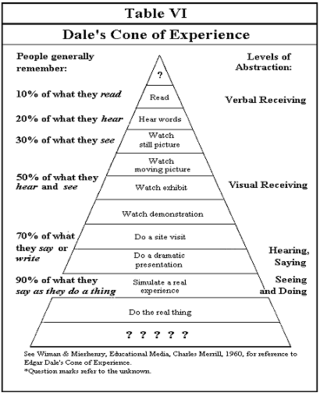
We Learn By Doing
Introduction
Inner-Stress Management, has been developed on the understanding that stress is not always a direct response to a stressor. Rather one?s resources and ability to manage the stress response. This allows changing the stress reaction, to a stress response.
Inner-Stress Management, requires identifying out feeling and patterns that are central to our life. Then by using the proven mindfulness based stress reduction, (MBSR) practices. We learn to understand and change our old reactions to unhealthy experiences to new responses that are healthier.
Lazarus and Folkman?s interpretation of stress focuses on the transaction between people and their external environment (known as the Transactional Model). The model contends that stress may not be a stressor if the person does not perceive the stressor as a threat. By recognizing our role in the possible over-reaction (self-stress) to the many unpleasant life experiences, we gain more inner-strength and self-confidence.
Also, if we use adequate stress management coping skills, then unhealthy stress may not actually be a result.? The model proposes that we can be taught to effectively manage our daily stressors. When we have the proper and safe training we can learn to change our perspective of the situation and provide our own the stress management skills to handle life’s many challenges.
Source- https://en.wikipedia.org/?
+++
Inner Stress? Management
Release Daily Stress
Rebalance? Emotions
Reduce Future Stress
Suggested Short Readings
PRACTICE
The Practice of “Stopping & Dropping”
(in progress)
APPLY
The more often we Stop & Drop, the more the nervous & hormonal systems come back into balance. Rather then being controlled from the emotion 2nd brain, all the parts of the brain came be more clearly be used. This allows for the cause of stressor to be investigate and understood. The more we understand about our own nature and the stressor the less stress we will produce.
Summary, the practice of ‘stopping & dropping’ is simple and effective. On the in breath we ‘stop, stop, stop’ and on the out breath we ‘drop, drop, drop.’ Stopping dos not mean we stop everything we are doing. We can still carry on a conversation, work etc. and drop into the present moment. We are only letting go of the emotions, the mind is holding onto. The challenge is in remember to do it.
+++
Restoring our energy
“Restoring our energy”
The Restoring Process
My experience of inner-stress management practices.
- It is first helpful to recognize the stressor.
- It is essential that I accepted that stress is a part of my self-care.
- Understanding my beliefs, changed my relationship to the stressor? from foe to friend.
Mindfulness for healing stress fatigue: the three R’s.
1. RESTING– includes gentle exercises, medications, wholesome foods, humour, sitting or resting quietly.
2. RELATING– what is my relationship to the stressor? There will be stress. How do I chose to relate to it?
3. RESTORING– how do I ground and rebalance my parasympathetic sympathetic nervous system?
Mindfulness of the Parasympathetic Nervous System (PNS)
Purpose:
Promotes healing, regeneration and nourishment of the body, and balances the immune system.
Emotional Content:
The PNS is activated by feelings of calmness, love, peacefulness, contentment, satisfaction and self-appreciation.
The PNS:
Is activated by rest, sleep, meditation, and relaxation techniques.
Laughter and tears are both usually signs of parasympathetic activity.
Decreases blood pressure, heart rate, blood glucose and heat production.
In this state, the mind can see the bigger picture and also turns inward for introversion, reflection, receptivity, and depression.
Is associated with feelings of ‘coming down’ (stopping & dropping) and release of tension such as disappointment, grief, shame, guilt, and despair.
Mindfulness of the Sympathetic Nervous System (SNS)
Purpose:
Promotes the ‘fight or flight’ response.
Emotional Content:
Is activated by negative emotions and thoughts including fear, sadness, anger, worry, resentment, and aggression.
The SNS:
Increases muscle tension
Creates stress and anxiety
Causes difficulty resting and sleeplessness
Increases the heart rate, blood pressure, blood sugar, and heat production
Increases adrenaline (epinephrine), insulin, cortisol and the thyroid hormones
Four parts of inner-stress management are:
- Grounding
- Resting
- Opening
- Understanding
+++
Basics
STRESS MEDITATION BASICS
Contents
1. OVERVIEW
2. QUESTIONNAIRE
3. INTEREST
4. POSTURE AND PAIN
5. ATTITUDE
6. STRESS MEDITATION
7. SPA LEARNING
8. THE ART OF MEDITATION
9. TIPS
=====================
1- MEDITATION OVERVIEW
Definition- (general term) Mental Development, having the ability to be relaxed and attentive.
History- For as long as there has been recorded history. Meditation has been used to release stress, rebalance emotions and
understand the nature of things.
Types- There are thousands of meditations with each having a specific purpose. But for simplicity we put them into one of 2
categories concentration or understanding.
1. Concentration- This is when we chose the object of meditation. Example- we may put our attention on the sensations of the
body breathing to calm down the mind.
2. Understanding- This is when the object of experience chooses us. Example- we watch the types of thoughts that arise in the
mind so we can understand their nature
Benefits- Physical lower blood pressure, faster and more complete healing etc.
Psychological: decreased anxiety, depression, irritability and moodiness
Increased self-actualization, feelings of vitality and rejuvenation, emotional stability
Increased happiness and improved learning ability and memory
——————————————————————-
2- QUESTIONNAIRE
Introduction- The following questionnaire may be useful in clarifying your meditation goals.
What would I like to get from meditation?
Improved Physical Health, Better Relationships, Reduced Stress, More Fun, Insights etc.
What type or types of meditation am I interested in?
Walking, Sitting, Lying, Chanting, Theravada, Zen, Tibetan etc.
Am I interested in meditations of a religious nature?
Christian, Jewish, Muslim etc.
Do I have any physical limitations for sitting for 10 ? 30 min?
What resources are available?
Books, CD?s Sitting Groups, Classes and Teachers
Am I really INTERESTED in learning how to meditate?
——————————————————————-
3- INTEREST*
“Interest is the zest of LIFE”
INTEREST is also the bases of learning. When we are interested in learning new things about ourselves and LIFE. There is a
natural energy that arises within us. Interest also contains the 2 qualities of ATTENTION & INTENTION that support all
meditation practices.
THE 2 QUALITIES OF INTEREST- Attention & Intention
1- Attention (awareness) Before we can change our inner experience of stress, it first has to enter into our conscious attention.
2- Intention (caring) Once we are aware of the object of experience, we bring to it a compassionate intention. (more …
——————————————————————-
4- POSTURE & PAIN
?Any meditation is better then no meditation.?
Posture- is important to receive the benefits of meditation.
Key points for all postures are for the:
* Spine to be straight.
* Chest to be open.
* Belly to be soft.
Pain- there will be some discomfort in the body at first. If the pain is strong, move enough to relief it. If the pain goes away after
10 minutes of moving around, no harm to the body has been done.
Time- it is better to meditate for short a period of time 1-7 minutes. Then to wait for when we may have 30-45 minutes.
——————————————————————-
5- NON-JUDGMENTAL ATTITUDE
?an non-judgmental attitude, ?is the hallmark of good Stress Meditation”
The non-judgmental attitude in meditation is different from daily living. Usually we reactively judge and push away unpleasant
experiences out of habit just. ?Rather then judging the experience as bad and allowing over anger to arise. Just be interest in
the experience without judging it. ?This way we have a learn a great deal about the nature of the experience. The next time the
same experience arises we will be more confident in responding to it, rather then over reacting to it.
It just is what it is and all inner experiences change with time. ?To help guide the mind in meditation we can offer silent inner
phrases of intention like “no thing to get”, “everything to know”, letting it all go” etc.
——————————————————————-
6- STRESS MEDITATION
?Stress affects both the body and the mind.?
We have found that stress can be effectively worked within 3 stages. Each of these stages has an associated STRESS
Meditation practice (see below). The practices then transfer into our daily activities.
1 ? Releasing Daily Stress, – We Practice ?Stopping & Dropping?
2 – Restoring The Emotions, – We Practice ?Opening & Smiling?
3 – Reducing Future Stress ? We Practice ?Naming & Claiming?
——————————————————————-
7- THE SPA MEDITATION LEARNING MODEL
?Study, Practice & Apply?
Introduction: The suggestion is that the more the body, heart and mind are understood. The less stress we hold. The 3 aspects
of this process are study, practice and understanding.
Study- Reading and listening to talks can provide different intellectual models of practice to consider. With study an INTEREST to
practice often occurs.
Practice- The practice of formal meditation and daily mindfulness (remember to come back into the present moment) allow for the
realization of new understandings to arise.
Apply- With open minded inquiry we gain insight into the true nature of stress and our role in it. These new understandings lead
to INTEREST in further study. Further study leads to more practice. Regular practice leads to more understanding. More
understanding = less stress. 
——————————————————————-
8- THE ART OF MEDITATION:
“To meditate is to become INTEREST in … , without being for or against it.”
“To meditate is to become INTERESTED in …
To be INTERESTED in the experiences of the present moment. Experiences of the body’s sensations, the heart’s emotions and
the mind’s thoughts.
…, without being for or against it.”
To acknowledge the experience by, just letting it be what it is. Without too much judgment (from past memories) or too much
expectation (of a future outcome).
——————————————————————-
9- MEDITATION TIPS:
?the mind is the forerunner of all things?
* The Rule- The Golden Rule of Meditation: “Do not force the mind.”
*Gentleness- Lightly guide the mind, with skillful phrases, e.g. “no thing to get”, “every thing to know”
*Protection- Protect the mind, from becoming overwhelmed with negative emotions or anxious thoughts by skillfully using
compassion. With a gentle but firm caring, return the awareness to the heavy, hard sensations of the hips and spine.
——————————————————————
MORE ABOUT ISM
Why INNER Stress Management?
The most damaging effects happen to the body and brain when we feel helpless or overwhelmed. By being proactive and
learning effective stress management skills we become more confident in dealing with stress. The more inner-self understanding
we have of our physical, emotional and mentally states, the less helpless and overwhelmed we will feel when outer stressful
events occur.
How do we learn INNER Stress Management?
After years of research, study, practice and teaching it has been found that stress can be effectively worked with in three
stages. Each of these stages has an associated STRESS Meditation practice (please see below).
Summary: In time as we practice we experience the deep and listening benefits of these 3 stress meditation practices. And
always keeping in mind ?it?s gotta be fun? or we are unlikely to practice.
For the next stage of study, please click-> How to Release Stress:
Benefits
?A happier way to live & work.?
Inner-Stress Management:
- 7- Core Practices
- 8- Workplace Skills
- 21- Short Mindful Exercises
The guiding phrases are:
??Practice, Practice, Practice?
?Just do the practice (mindfulness) and let the practice do the work.?
Daily Mindfulness Produces:
Less: Stress, Anxiety, Conflict
More: Creativity, Satisfaction, Productivity
Benefits (personal)
Has a strong self-care theme?.?
Effective both reducing stress and anxiety?.?
Provides all the basic mindfulness practices?.?
Practical examples of working more mindfully?.?
Benefits (company)
Shows employer cares
Improved workplace culture
Increased creativity & accuracy
?Decreased grievances & sick days
Features
Unlimited email support?
iPad and Smartphone compatible.
Self-paced & no previous experience is required.
All course materials are downloadable, to use later.
Privacy
The employer buys the course credits.?
?Identification & Passwords are kept private.?
?Employer does not see the usage of the training.?
Content
8 ?Workplace Skills
7- Mindfulness Attitudes
8- Core stress reducing practices
12- Quick mini-mindfulness practices
27- Q&A to help apply the course in workplace
41- Future topics i.e.? Gossip, or? Multitasking
+++++++++++++++++++
Participants in the MBSR Program have enjoyed significant changes to their health and lifestyle including improved:
* Creativity
* Energy levels
* Ability to relax
* Emotional intelligence
* Concentration and focus
* Interpersonal relationships
* Physical & psychological symptoms
* Ability to cope with stressful situations
Three decades of published research have shown that the MBSR program has been valuable in these common health issues:
* Cancer
* Anxiety
* Psoriasis
* Infertility
* HIV/AIDS
* Fibromyalgia
* Panic disorder
* Heart disease
* Recurrent depression
* Chronic pain syndrome
* Irritable bowel syndrome
* Chronic fatigue syndrome
* Workplace and family stress
+++
ideas
mindful methods for life- MML is an adventure in self-discovery and self-transformation. Life is a wild ride! Stress happens! You will learn over 20 techniques to soothe yourself in times of stress. You will decide which techniques work for you in any given situation. Maybe 10 out of the 20 techniques will be your favorites. Then, in times of stress or discomfort, one of those techniques is bound to be JUST WHAT YOU NEED WHEN YOU NEED IT THE MOST.
WORKSHOP OVERVIEW Next- How to Basics
OBJECTIVE: To provide educational materials & practices to have more fun & less stress?.
GOALS: The 3 Goals of Stress Meditation to:
1. Release daily stress.
2. Restore the emotions.
3. Reduce future stress.
SPA LEARNING SYSTEM:-)
Study: What will be taught?
? How use awareness of the body to releases stress.
? How to care for what is what is happening in our body, heart and mind.
? How to inquire and understand the stressor, allowing more enjoyment of life.
Practice: We practice the development of intention and attention. The 3 practices are:
1. ?Stopping & Dropping? (to release daily stress)
2. ?Opening & Smiling? (to restore the emotions)
3. ?Inquiring to Understand? (to reduce future stress)
Apply: These practices can result in learning new skills that can then transfer into your daily life. Reducing stress and improving
relationships, creativity and your emotional intelligence quotient (EQ).
PSYCHOLOGICAL BENEFITS:
* Decreased, anxiety, depression, irritability and moodiness
* Increased, happiness, emotional stability, learning ability and memory
DISCUSSION TOPICS:
The Science of:
- The 1, 2, 3 brain
- The breath the body
- The 3 nervous systems
- The 4 hormonal systems
- How meditation heals stress
The Principles of:
- Remembering to be interested
- Grounding back into the present moment
- Opening the heart to connect
- Knowing what is in the body, heart and mind
- Understanding to reduce future stress
MEDITATION TIPS:
*Continuously, let go of expecting too much of ourselves or of the meditation.
*When confused or concerned always gently return to the grounding sensations of the body.
*Life can sometimes be taken too seriously, Yogi?s motto is. ?its gotta be fun?
CONCERNS:
? In all movements and meditations, please do only what feels comfortable for you.
? Not religious, based on western science, eastern meditation & experience.
? If you have any concerns or questions please let us know.
Disclaimer:
1. All materials are for educational purposes only and do not to take the place of professional care.
2. Generalizations are used sometimes to simplify the complexities of the body, heart and mind.
++++++++++++
INNER Stress Management- Classes at Conestoga College
Learn 2 simple meditations that effectively:
Release Daily Stress
Restore Emotional Energy
Why INNER Stress Management?
The most damaging effects happen to the body and brain when we feel helpless or overwhelmed. By being proactive and learning
effective stress management skills we can become more confident in dealing with stress. The more inner-self understanding we have
of our physical, emotional and mentally states, the less helpless and overwhelmed we will feel when stressful events happen.
About INNER Stress Management
Stress is an important part of life. We need it to grow. If stress is turning into distress it requires healthy management skills. We
suggest managing stress from the inside-out. Outside stressors can not be eliminated, but we can change our inner relationship with
the stress in our lives. The goal is to develop three simple inner management skills.
The Workshop includes a 3 part learning model for INNER Stress Management:
* Study materials on stress-loops, nervous system, hormonal system and emotional energy.
* Practice to release stress from the body and restore the mental energy.
* Apply what has been learned from the practices in our everyday life.
Ross Clark has studied meditation in Asia and under many senior meditation teachers in North America. He has also completed the
Mindfulness Based Stress training at the University of Massachusetts Medical School.
What- Inner Stress Meditation
When- 4 weeks- March, Tue 4, 11, 18, 25
Where- Conestoga College (Doon Campus)
Cost- $195?
Contact- Conestoga College
Website- www.innerstressmanagement.com
++++++++++++++++
Stress Meditation-
This beginner’s course is ideal for those who are curious about meditation and its many benefits. The meditations are short and
simple. You will learn 3 meditation postures standing, sitting, and walking. We will cover the why and how of meditation and its role
in reducing stress. The courses goal is to, learn Stress Meditation skills and to have some fun doing it.
Ross Clark has studied meditation in Asia and under many senior meditation teachers in North America. He has also completed the
Mindfulness Based Stress training at the University of Massachusetts Medical School.
What- Stress Meditation
When- 2 weeks- Feb, Tue 12, 19
Where- Conestoga College (Doon Campus)
Cost- $99
To Register- Call Conestoga College 519-748-5220
Website– www.InnerStressManagement.com
For more information, Please Contact:
Ross Clark 519-648-2985 or StressReductionTraining@gmail.com
Why Meditate
?20 Scientific Reasons to Start Meditating Today
New research shows meditation boosts your health, happiness, and success!
Post published by Emma M. Sepp?l? Ph.D. on Sep 11, 2013 in Feeling It
I started meditating soon after 9/11. I was living in Manhattan, an already chaotic place, at an extremely chaotic time. I realized I had no control over my external environment. But the one place I did have a say over was my mind, through meditation. When I started meditating, I did not realize it would also make me healthier, happier, and more successful. Having witnessed the benefits, I devoted my PhD research at Stanford to studying the impact of meditation. I saw people from diverse backgrounds from college students to combat veterans benefit. In the last 10 years, hundreds of studies have been released. Here are 20 scientifically-validated reasons you might want to get on the bandwagon today:
It Boosts Your HEALTH
1 – Increases immune function (See?here (link is external)?and?here (link is external))
2 – Decreases Pain (see?here (link is external))
3 – Decreases Inflammation at the Cellular Level (See?here (link is external)?and?here (link is external)?and?here (link is external))
It Boosts Your HAPPINESS
4 – Increases Positive Emotion (here (link is external)?and?here (link is external))
5 – Decreases Depression (see?here (link is external))
6 – Decreases Anxiety (see?here (link is external)?and here (link is external) and?here (link is external))
7 – Decreases Stress (see?here (link is external)?and ?here (link is external))
It Boosts Your SOCIAL LIFE
Think meditation is a solitary activity? It may be (unless you meditate in a group which many do!) but it actually increases your sense of connection to others:
8 – Increases social connection & emotional intelligence (see?here (link is external)?and – by yours truly -?here (link is external))
9 – Makes you more compassionate (see?here (link is external) and here (link is external) and here (link is external))
10 – Makes you feel less lonely (see?here (link is external))
It Boosts Your Self-Control
11 – Improves your ability to regulate your emotions (see?here (link is external)) (Ever flown off the handle or not been able to quiet your mind? Here’s the key)
12 – Improves your ability to introspect (see?here (link is external)?& for why this is crucial see?this post)
It Changes Your BRAIN (for the better)
13 – Increases grey matter (see?here (link is external))
14 – Increases volume in areas related to emotion regulation, positive emotions & self-control (see?here (link is external)?and?here (link is external))
15 – Increases cortical thickness in areas related to paying attention (see?here (link is external))
It Improves Your Productivity (yup, by doing nothing)
16 – Increases your focus & attention (see?here (link is external)?and?here (link is external)?and?here (link is external)?and?here (link is external))
17 – Improves your ability to multitask (see here (link is external))
18 – Improves your memory (see?here (link is external))
19 – Improves your ability to be creative & think outside the box (see research by?J. Schooler (link is external))
20. It Makes You WISE(R)
It gives you perspective: By observing your mind, you realize you don’t have to be slave to it. You realize it throws tantrums, gets grumpy, jealous, happy and sad but that it doesn’t have to run you.?Meditation is quite simply mental hygiene: clear out the junk, tune your talents, and get in touch with yourself.?Think about it, you shower every day and clean your body, but have you ever showered your mind??As a consequence, you’ll feel more clear and see thing with greater perspective. “The quality of our life depends on the quality of our mind,” writes Sri Sri Ravi Shankar. We can’t control what happens on the outside but we do have a say over the quality of our mind. No matter what’s going on, if your mind is ok, everything is ok. Right now.
It Keeps You Real
Once you get to know your mind, you start to own your stuff and become more authentic, maybe even humble. You realize the stories and soap operas your mind puts you through and you gain some perspective on them. You realize?most of us are caught up in a mind-drama?and become more compassionate towards others.
And…the more you meditate, the more you seem to benefit, research studies such as this (link is external) one suggest.
Myths about Meditation
Having an empty mind?nope, in fact, when you start meditating, you’ll find its quite the opposite
Sitting in lotus position?nope, you can sit on the couch (just don’t lie down, you’ll fall asleep)
Sitting for an hour a day?nope, small doses work just fine, (see?here (link is external)?and – by yours truly -?here) (link is external)
Chanting in a language I don’t understand?nope, not unless that floats your boat
Buddhist,?Hindu or religious?nope, not unless you make it so
Weird?what’s so weird about sitting and breathing? Besides, US congressmen (link is external), NFL football leagues (link is external)?and the US Marine Corps (link is external)are?doing it, how weird can it be?
Wearing robes?what?
“I can’t meditate” because
I can’t clear my mind?no worries, while you’re sitting there you’ll experience the noisy chaos of a wound up mind that’s unwinding: tons of thoughts, feelings and emotions. Don’t worry about how you feel during, notice how you feel after and throughout the rest of the day
I can’t sit still?that’s ok, just sit comfortably, fidget if you need to
I get anxious?that’s also normal, all the junk’s coming up, learn some breathing practices to calm yourself down, exercise or do yoga before meditating
I hate sitting still?that’s fine, then go for a walk without your earphones, phone etc; or start with yoga; or do breathing exercises?give yourself time to just “be” without constantly “doing” something
I tried and I hated it?there’s not just one kind of meditation, there’s a whole menu out there, look for the shoe that fits: mindfulness, Transcendental, compassion, mantra, Vipassana, Art of Living breathing practices, yoga nidra, yoga, insight, loving-kindness, tai chi etc…
I don’t have time – if you have time to read an article about meditation all the way through, you have time to meditate. Think of all those minutes you waste every day on the internet or otherwise, you can definitely fit in 20 minutes here or there to give your life a boost! Gandhi is quoted as saying “I’m so busy today, that… I’m going to meditate 2 hours instead of 1.”
Source- https://www.psychologytoday.com/blog/
+++
ideas
mindful methods for life- MML is an adventure in self-discovery and self-transformation. Life is a wild ride! Stress happens! You will learn over 20 techniques to soothe yourself in times of stress. You will decide which techniques work for you in any given situation. Maybe 10 out of the 20 techniques will be your favorites. Then, in times of stress or discomfort, one of those techniques is bound to be JUST WHAT YOU NEED WHEN YOU NEED IT THE MOST.
WORKSHOP OVERVIEW Next- How to Basics
OBJECTIVE: To provide educational materials & practices to have more fun & less stress?.
GOALS: The 3 Goals of Stress Meditation to:
1. Release daily stress.
2. Restore the emotions.
3. Reduce future stress.
SPA LEARNING SYSTEM:-)
Study: What will be taught?
? How use awareness of the body to releases stress.
? How to care for what is what is happening in our body, heart and mind.
? How to inquire and understand the stressor, allowing more enjoyment of life.
Practice: We practice the development of intention and attention. The 3 practices are:
1. ?Stopping & Dropping? (to release daily stress)
2. ?Opening & Smiling? (to restore the emotions)
3. ?Inquiring to Understand? (to reduce future stress)
Apply: These practices can result in learning new skills that can then transfer into your daily life. Reducing stress and improving
relationships, creativity and your emotional intelligence quotient (EQ).
PSYCHOLOGICAL BENEFITS:
* Decreased, anxiety, depression, irritability and moodiness
* Increased, happiness, emotional stability, learning ability and memory
DISCUSSION TOPICS:
The Science of:
- The 1, 2, 3 brain
- The breath the body
- The 3 nervous systems
- The 4 hormonal systems
- How meditation heals stress
The Principles of:
- Remembering to be interested
- Grounding back into the present moment
- Opening the heart to connect
- Knowing what is in the body, heart and mind
- Understanding to reduce future stress
MEDITATION TIPS:
*Continuously, let go of expecting too much of ourselves or of the meditation.
*When confused or concerned always gently return to the grounding sensations of the body.
*Life can sometimes be taken too seriously, Yogi?s motto is. ?its gotta be fun?
CONCERNS:
? In all movements and meditations, please do only what feels comfortable for you.
? Not religious, based on western science, eastern meditation & experience.
? If you have any concerns or questions please let us know.
Disclaimer:
1. All materials are for educational purposes only and do not to take the place of professional care.
2. Generalizations are used sometimes to simplify the complexities of the body, heart and mind.
++++++++++++
INNER Stress Management- Classes at Conestoga College
Learn 2 simple meditations that effectively:
Release Daily Stress
Restore Emotional Energy
Why INNER Stress Management?
The most damaging effects happen to the body and brain when we feel helpless or overwhelmed. By being proactive and learning
effective stress management skills we can become more confident in dealing with stress. The more inner-self understanding we have
of our physical, emotional and mentally states, the less helpless and overwhelmed we will feel when stressful events happen.
About INNER Stress Management
Stress is an important part of life. We need it to grow. If stress is turning into distress it requires healthy management skills. We
suggest managing stress from the inside-out. Outside stressors can not be eliminated, but we can change our inner relationship with
the stress in our lives. The goal is to develop three simple inner management skills.
The Workshop includes a 3 part learning model for INNER Stress Management:
* Study materials on stress-loops, nervous system, hormonal system and emotional energy.
* Practice to release stress from the body and restore the mental energy.
* Apply what has been learned from the practices in our everyday life.
Ross Clark has studied meditation in Asia and under many senior meditation teachers in North America. He has also completed the
Mindfulness Based Stress training at the University of Massachusetts Medical School.
What- Inner Stress Meditation
When- 4 weeks- March, Tue 4, 11, 18, 25
Where- Conestoga College (Doon Campus)
Cost- $195?
Contact- Conestoga College
Website- www.innerstressmanagement.com
++++++++++++++++
Stress Meditation-
This beginner’s course is ideal for those who are curious about meditation and its many benefits. The meditations are short and
simple. You will learn 3 meditation postures standing, sitting, and walking. We will cover the why and how of meditation and its role
in reducing stress. The courses goal is to, learn Stress Meditation skills and to have some fun doing it.
Ross Clark has studied meditation in Asia and under many senior meditation teachers in North America. He has also completed the
Mindfulness Based Stress training at the University of Massachusetts Medical School.
What- Stress Meditation
When- 2 weeks- Feb, Tue 12, 19
Where- Conestoga College (Doon Campus)
Cost- $99
To Register- Call Conestoga College 519-748-5220
Website– www.InnerStressManagement.com
For more information, Please Contact:
Ross Clark 519-648-2985 or StressReductionTraining@gmail.com